

December is upon us and summer has arrived with bushfires in Queensland and flooding rains in NSW. Our best wishes go out to all those affected as well as our brave emergency services workers. And to all our clients, we wish you a safe and happy holiday season.
We would like to provide you with an update on the potential changes proposed by the Labor government which may occur in 2019. We have attempted to summarise the current situation and their potential implications.
Franking Credits
Beginning on 1st July 2019 the Labor party has proposed changes to the dividend imputation system involving the removal of refundable franking credits.
Negative Gearing
A proposal to reduce negative gearing benefits.
Capital Gains Tax Discount
A proposal for 1st July 2019 has been made to halve the Capital gains tax discount from 50% to 25%.
Non-Concessional Contribution Cap
There has been a proposal to lower the non-concessional contributions cap from $100,000 to $75,000.
It is important to note that these changes will require Labor winning the next election and also pass through both the upper and lower house.
Please feel free to contact our office on 02 9223 0911 if you would like us to discuss this with you further.
 We’re coming up to the festive season and for all its fun and frivolity, it’s also a time when we loosen the purse strings to accommodate the excess.
We all know there’s nothing worse than starting the new year with unpaid debt. Making a solid plan for your silly season spend can make a big difference and will help you avoid a holiday debt hangover.
The Christmas frenzy is pretty powerful. Even the biggest Scrooges in our midst can succumb. And it’s not hard to see why. We are bombarded with marketing from all corners at this time of year leading us to make purchases we normally wouldn’t without really giving them much thought. This can all be rather fun in the moment but can result in anxiety come January, when the credit card bill is due.
One way to manage this pressure to spend is to be aware of the psychological concepts marketers employ to turn a sale. Scarcity theory is a big one.i Creating the perception that an item is limited in some way is a great way to close a deal. And Christmas provides a line in the sand that few can resist.
There’s also the fact that the brain produces dopamine when it anticipates reward rather than upon receiving the reward itself.ii The hype and anticipation around Christmas provides a dopamine hit making it hard to resist the sensory overload of the decorations and carols when you hit the shops.
The best way to counter this marketing frenzy is to remind yourself what Christmas is really about for you and your family. For most of us it’s reconnecting with our loved ones, sharing a meal, and finding some way to give back. This doesn’t have to be material in nature. There are plenty of ways to show someone you care that don’t involve expensive purchases. Giving someone your time, or lending them an ear, can often be so much more valuable.
Now’s also the time to have the chat about Christmas values with your children. Kids are particularly susceptible to the holiday hype. And if you want to maintain your budget and avoid the sulks come Christmas morning, setting some boundaries around what they can expect gift-wise can be helpful (Santa may have some limitations on what he can carry).
The average Australian credit card holder spent $3,342 on plastic in December last year.iii Worryingly, many were unable to pay it back for months, often accruing unnecessary interest. Credit cards can be handy if used correctly. But you need to ensure you have the cashflow to meet your repayments. Having a holiday season budget will help here.
Another trend to be aware of is Afterpay. A bit like layby except you get the product immediately, for many it is a form of forced budgeting, but for others it can lead to making purchases they can’t afford, and the late repayment fees can really add up.
It’s important to remember everyone has different means and expectations around the festive season. There’s no point trying to keep up with the Joneses if it’s going to put a dampener on the rest of your summer. If, on the other hand, you’re one of the lucky ones who has the ways and means to live large at Christmas, remember not everyone does.
We call it the silly season for a reason. And there’s no harm in spending a bit more in December in the name of fun and family. We all have our limits however, and knowing yours could help you avoid a holiday hangover in the New Year.
i http://theconversation.com/the-psychology-of-christmas-shopping-how-marketers-nudge-you-to-buy-88011
ii https://www.theguardian.com/science/punctuated-equilibrium/2011/aug/11/1
iii https://www.news.com.au/finance/australians-are-being-warned-not-too-overspend-on-their-credit-cards-this-christmas/news-story/2cf080bfd59c545f9b9e34770c564f95
 protect your family all year round.
When you are enjoying the summer break with your loved ones, it can be hard to imagine anything could ever go wrong. But life is unpredictable, which is why life insurance is so important, particularly when you have people who depend on you.
Whether you are a young couple starting out, a growing family with kids at school and a mortgage, or empty nesters with debts to clear before retirement, having the right insurance cover could make a world of difference if the unthinkable happened.
Life insurance is not one product but many, to cover a range of needs. If you are unsure which cover is right for your family, begin by asking yourself a series of ‘what ifs’.
You probably insure your car and your home, but the impact on your family is potentially much greater if you lose the ability to earn an income. Whether you are out of action for months or years, few families have enough savings to tide them over until you recover and return to work.
The solution is Income Protection insurance, also called Income Replacement or Salary Continuance cover. This replaces up to 75 per cent of your current income if you are unable to work due to illness or injury. Depending on the policy, it can cover you for short or long periods, sometimes up to age 65, after various waiting times.
The survival rates for critical illnesses such as heart attack, cancer and stroke are improving, but recovery can take a long time and the financial and emotional toll on your family can be high.
The solution is Trauma insurance, also called Critical Illness. This pays a lump sum if you are diagnosed or suffer one of a specific list of illnesses. You could use the money to reduce your working hours, spend time recovering with your family, or to pay for treatment, rehabilitation or a carer.
A serious injury or illness can come out of the blue, leaving you unable to provide for your family. A government Disability Pension is unlikely to fully replace your previous salary. And the National Disability Insurance Scheme, while providing care packages, does not pay regular income or a lump sum.
The solution is Total and Permanent Disability (TPD) insurance. This pays a lump sum which you can use to pay off debts, cover medical costs or invest to provide regular income to help maintain your family’s lifestyle.
It’s a sad fact that any of us could be diagnosed with a terminal illness or die prematurely in an accident. If this happened to you, how would your partner and children cope emotionally and financially? The kids still need to be fed, clothed and educated, the mortgage or rent must be paid, and your partner may need time off work for extra caring duties, adding to the financial pressure. If you don’t have kids or they have left home, your partner could be left with a mortgage and other debts.
The solution is Life cover, also called Term Life or Death cover. This pays a lump sum on your death or the diagnosis of a terminal illness, allowing your family to focus on supporting each other, secure in the knowledge that the bills will be paid.
All these policies can be bought separately or bundled together as often happens with Death and TPD cover.
You may already be covered for some level of insurance via your super fund, however it might not be adequate for your needs. It’s important to have insurance that is tailored to your personal circumstances, that will protect your family’s financial and emotional well-being come what may. We are here to help.
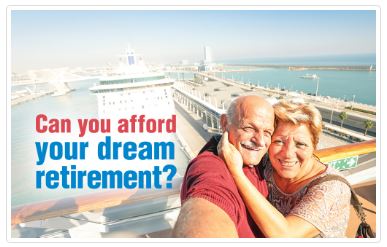 Planning your dream retirement can be an exciting time. The chance to travel overseas or around Australia without having to rush back to work, time to pursue new hobbies, learn a language or spend time with the grandkids. The possibilities are endless, but what will it cost?
And that’s the big unknown, because none of us know how long we will live.
Today’s 65-year-olds can expect to live to an average age of 84.6 years for men and 87.3 for women, or roughly 20 and 22 years respectively in retirement. That’s a long time, and it’s only an average. Half will live longer than that.i
The challenge is to ensure your cash lasts the distance, however long that may be.
A good way to begin thinking about your retirement needs and working out a budget is to visit the ASFA Retirement Standard, where you will find detailed budgets for different households and living standards.ii
The ASFA Retirement Standard calculates that singles aged around 65 would need $27,425 a year to live a modest lifestyle while couples would need $39,442. A comfortable lifestyle would cost $42,953 for singles and $60,604 for couples.
To put this in perspective, the full age pension is currently $23,823.80 a year for singles and $35,916.40 for couples.iii As you can see, this does not stretch to ASFA’s modest budget, let alone a comfortable lifestyle, especially for pensioners who are paying rent or still paying off a mortgage.
Of course, everyone’s needs will be different. Some people may need to spend more on their health, while a contented gardener and homebody may need less money than a keen global traveller with a season ticket to opera, theatre or football.
It’s also important to recognise that your spending patterns are likely to change in predictable ways over the course of your retirement, determined by your health and mobility.
Most people go through three phases of retirement.
Australians are living longer, healthier lives which means many of us can expect to enjoy almost as many years in retirement as we did in the workforce. And that requires careful financial planning.
Before you can set financial targets and investment objectives, you need to work out what your dream retirement might cost.
If you would like help to make your retirement dream a reality, give us a call.
i https://www.aihw.gov.au/getmedia/7b986857-7b41-4aae-b7ff-eab57eb20f13/20457.pdf.aspx?inline=true
ii https://www.superannuation.asn.au/resources/retirement-standard
iii https://www.humanservices.gov.au/individuals/services/centrelink/age-pension/eligibility/payment-rates
When planning your next holiday, keep in mind that you are eligible to receive discounted travel insurance via Fast Cover as part of our client discount program.

Discounted Travel Insurance with FastCover
Click here to access the travel insurance quote calculator.
While Christmas holiday is a time to enjoy yourself, there are certain things to keep in mind in terms of cyber crime prevention and safety especially when travelling.
Use the following guideline to make your gadgets more secure.
To read more about how to protect your personal information this, please click here.Reference : Australian Government, Stay Smart Online
https://www.staysmartonline.gov.au/protect-yourself/protect-your-stuff
Please note this information is of a general nature only and has been provided without taking account of your objectives, financial situation or needs. Because of this, we recommend you consider, with or without the assistance of a financial advisor, whether the information is appropriate in light of your particular needs and circumstances.
Copyright in the information contained in this site subsists under the Copyright Act 1968 (Cth) and, through international treaties, the laws of many other countries. It is owned by EFDB Pty Ltd unless otherwise stated. All rights reserved. You may download a single copy of this document and, where necessary for its use as a reference, make a single hard copy. Except as permitted under the Copyright Act 1968 (Cth) or other applicable laws, no part of this publication may be otherwise reproduced, adapted, performed in public or transmitted in any form by any process without the specific written consent of EFDB Pty Ltd.
EFDB Pty Ltd | Sydney CBD | Northern Beaches | ABN 64 112 871 922 | AFSL 311720

© 2025 EFDB Pty Ltd trading as Diamond Blue Financial Services, ABN 64 112 871 922, AFSL 311720. SiteSuite Websites